
August Newsbreak
In this issue of Newsbreak:
Leadership + AI Summit: The Room Is Taking Shape
Member Discount Ends August 31
Copyright Registration Fees: What’s Ahead
Copyright + AI Litigation Update
DMLA / Member / Industry News
Upcoming Industry Events
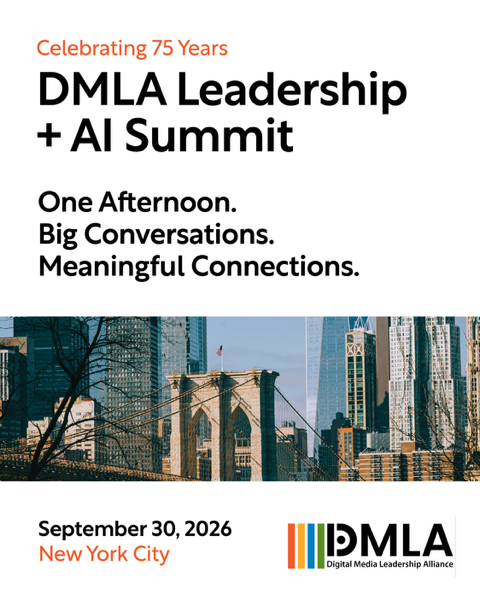
The Conversation is moving to New York!
The pace of change across visual media continues to accelerate. AI, new licensing models, provenance and authenticity, changing approaches to discovery, and rapidly evolving copyright questions are reshaping both the opportunities and responsibilities facing our industry.
On September 30, DMLA will bring leaders from across content, technology, publishing, AI and law together at the Harvard Club in New York for an afternoon focused on those questions—and on where we go from here.
The program now includes Kira Pollack’s keynote on the responsible use of AI to preserve, authenticate and unlock visual history; leadership conversations examining industry transformation and the development of a trusted AI ecosystem; and interactive roundtables designed to give attendees a direct role in identifying priorities for DMLA and the industry’s next chapter.
If you have been considering attending, August is the time to register.
DMLA’s discounted registration pricing ends August 31 .
Copyright Corner
Copyright Office Sends Final Fee Proposal to Congress
In July, the U.S. Copyright Office submitted its final proposed fee schedule to Congress. Congress now has 120 days to enact legislation disapproving the proposal; otherwise, the new fees are expected to take effect this fall.
For creatives, the proposal would increase the fee for group registration of published or unpublished photographs from $55 to $85—an increase of approximately 55%.. The Office specifically acknowledged that photographers create large volumes of works and have consistently raised concerns about the cost of protecting them. It also said future registration-system improvements are planned that would allow published and unpublished photographs in the same submission and permit larger numbers of images per application.
Why it matters: For photographers, agencies, archives and other high-volume visual-content businesses, registration costs directly affect how many works are registered—and ultimately how effectively those works can be protected. DMLA continues to believe that participation in the registration system should be treated as a measure of its success, and that fee structures should not discourage creators and rightsholders from registering their work.
The Copyright Office says it is continuing to study alternative structures including tiered and subscription pricing, informed by comments received earlier this year.
We are working with the Copyright Alliance to share our feedback with Congress.
Visual Copyright Litigation Continues to Test AI Training
The legal battle over the use of copyrighted visual content in generative AI continues to develop on both sides of the Atlantic.
DMLA member, Getty Images' closely watched litigation against Stability AI remains active. In November 2025, the UK High Court rejected Getty's secondary copyright infringement claim relating to Stable Diffusion, finding that the AI model itself did not constitute an infringing copy under UK law. Getty had previously withdrawn its primary training-related copyright claim because of jurisdictional issues. The court nevertheless found limited trademark infringement involving Getty Images watermarks, and Getty has received permission to appeal the secondary copyright ruling.
Getty is also continuing its separate U.S. litigation against Stability AI in California, where several trademark-related claims survived a motion to dismiss earlier this year.
Now, another major visual-content company has entered the fight. Evox Productions filed suit in July against Stability AI, Runway AI, Hugging Face and DeviantArt, alleging unauthorized use of its professional automotive photography in datasets used in developing generative-AI systems.
Why it matters: Taken together, these cases are increasingly putting the practices surrounding the acquisition and use of professional image libraries for AI training before the courts. While the Getty UK decision resolved some specific questions under UK law, it did not settle the broader question of whether—and under what circumstances—copyrighted visual content may lawfully be used to train generative AI systems.
NO FAKES Act Continues to Advance
The revised NO FAKES Act of 2026 would establish a federal right protecting individuals against unauthorized digital replicas of their voice and visual likeness. The bill was introduced in May and advanced unanimously through the Senate Judiciary Committee in June, positioning it for consideration by the full Senate.
Why it matters: While NO FAKES is not traditional copyright legislation, it is becoming an increasingly important part of the broader rights framework surrounding generative AI, synthetic media, authenticity and creator control. DMLA will continue to follow and report on its progress.
International courts continue weighing AI training
At the end of July, a Munich court ruled in favor of German collecting society GEMA in its copyright action against AI music company Suno, finding infringement in connection with copyrighted songs used by the company's system. Suno has indicated it may appeal.
Why it matters: The decision is another indication that questions surrounding AI training, licensing and copyright are being answered differently across jurisdictions—an increasingly important consideration for companies operating globally.
Industry Briefs:
EU AI Act Transparency Rules Take Effect
On August 2, the transparency provisions of the EU AI Act became applicable, introducing new requirements around AI-generated and manipulated content. Providers of generative AI systems are required to enable machine-readable identification of AI-generated or manipulated content, while certain deployers must disclose deepfakes and other AI-generated material. The European Commission has also published implementation guidelines and a voluntary Code of Practice to support compliance.
Why it matters: These rules move questions of provenance and disclosure from industry best practice toward regulatory obligation. For visual-content companies operating in or serving Europe, the implications for metadata, labeling, content workflows and authenticity standards will be important to watch.
Reuters Consolidates Visual Licensing and Expands AI-Assisted Workflows
Reuters has made Reuters Connect the primary destination for licensing its news picture and video content, bringing Reuters Pictures, Imagn sports imagery and the Screen Ocean video archive into a single platform. The platform incorporates AI-powered search and discovery tools. Reuters followed that announcement this month with live AI-generated, time-coded video transcription designed to accelerate clipping, verification and publishing workflows.
Why it matters: This is a good example of an established media company using AI not as a replacement for licensed content, but as infrastructure to make authoritative content easier to discover, work with and monetize.
Provenance Moves Further Into the Camera and Publishing Workflow
Content authenticity technology continues to move beyond theory and into production workflows. A growing range of professional cameras now supports C2PA-based Content Credentials at or near the point of capture, while publishers and platforms continue expanding their ability to carry and display provenance information. C2PA is designed to provide a verifiable record of a digital asset's origin and editing history.
Why it matters: As synthetic imagery becomes increasingly difficult to distinguish visually from camera-captured photography, provenance is becoming part of the infrastructure surrounding professional visual content—not simply a downstream labeling exercise.
Reuters Editor-in-Chief: AI Content Should Be Licensed, Attributed and Paid For
In a July address, Reuters Editor-in-Chief Alessandra Galloni argued that as AI systems become another way people access news, established licensing principles should continue to apply. She emphasized attribution, preservation of editorial meaning and fair compensation for journalism used in AI products. Reuters itself is pursuing AI-related licensing while also incorporating AI into its newsroom and content-distribution workflows.
Why it matters: Her remarks reflect a broader shift in the discussion from whether media companies should engage with AI companies toward the terms under which that engagement can support sustainable content businesses.
Interested in DMLA Membership?
Benefits of Membership
Join Us
Committees
AI/Copyright Group
SEO/AISearch Working Group
Coming Industry Events
September 16, 2026 - Footage Marketplace Europe, Paris, France
September 29 - 30 - Visual 1st 2026, San Francisco, CA
September 30 - DMLA Leadership + AI Summit, New York City
October 1-2 - DAM NY 2026, New York City
October 1-3 - Footage Fest, New York City
November 10 - 12 - AdobeMax - Miami, FL
Please send us events you would like us to track!
Email marketing@dmla.org